
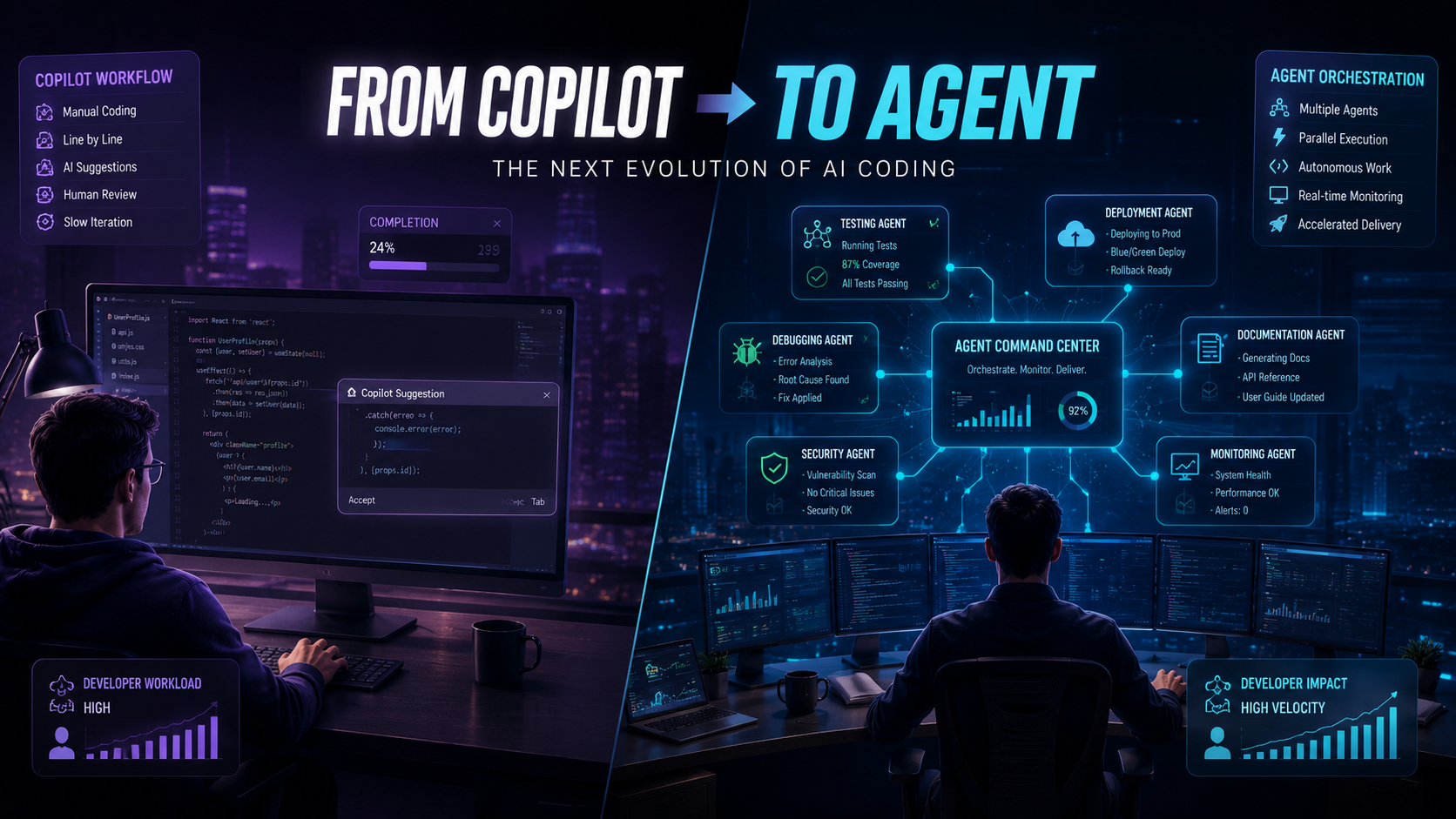
From Copilots to Agents: What Agentic AI Means for Software Development in 2026
For the last two years, AI in software development meant one thing: smarter autocomplete.
Tools suggested your next line, fixed small errors, or wrote simple functions. You were still in control. The AI only made your work faster.
But that’s changing in 2026.
Now, the conversation is different. Teams are no longer asking which AI tool to use. Instead, they’re asking how much work they can trust AI to handle on its own.
This shift is bigger than it looks.
Today’s AI doesn’t just assist. It can research problems, write code, test it, and even fix issues—often before a developer reviews anything.
That means faster development. However, it also introduces new risks.
Without proper control, teams can face issues with code quality, security, and governance. And most companies are not fully prepared for this shift yet.
What Actually Changed: Copilot vs. Agent
A copilot is reactive. The human makes every decision; the AI just makes the typing faster.
An agent works differently. Give it a goal — refactor this module, fix this failing test suite, migrate this API to the new schema — and it plans its own steps, writes the code, runs the tests itself, reads the failures, and tries again. It might open a pull request when it’s done. The person reviews the outcome, not the individual keystrokes that got there.
The practical difference shows up in scale. A copilot saves you minutes per function. An agent can absorb a task that used to require days of focused engineering time and turn it into something a developer reviews in an afternoon.
Why 2026 Is the Tipping Point
A few things converged to make this the year agentic AI stopped being a demo and started being a deployment decision:
- Codebase understanding caught up. Tools can now reason about the relationships and history inside a repository, not just isolated lines of code — which is what makes multi-step, unsupervised work reliable enough to trust.
- Multiagent systems became mainstream. Instead of one general-purpose assistant trying to do everything, teams of specialized agents now divide a task between them, each handling a piece it’s tuned for. Analysts at Gartner named this one of the defining strategic technology trends of 2026.
- Daily usage became the norm, not the exception. A majority of professional developers now reach for AI tools every working day, and the split between “using AI” and “not using AI” has largely closed. The remaining question is how much responsibility teams hand over.
- Budgets followed the behavior. Enterprise spending on generative AI tooling jumped sharply year over year, and that money increasingly funds agent platforms and orchestration, not just chat assistants.
The Part Nobody Puts in the Pitch Deck
Here’s the half of the story that doesn’t make it into most vendor presentations: a meaningful share of agentic AI projects are expected to be abandoned or scrapped within the next couple of years. Industry analysts have been blunt about why it’s rarely because the technology fails. It’s because companies point an agent at a broken or undocumented process, skip the governance work, and assume “agentic” is a feature you switch on rather than a way of working you have to design for.
An agent that’s allowed to “just handle it” without a clear boundary on what it can touch, what needs a human sign-off, and how its output gets tested is a liability dressed up as a productivity tool. The businesses getting real value aren’t the ones with the most agents running. They’re the ones who picked one well-defined, verifiable workflow, built proper checks around it, and expanded from there.
What This Means If You’re Running a Business, Not Just a Dev Team
If you’re a founder, product owner, or IT decision-maker rather than someone writing code day to day, the practical takeaways are simpler than the hype suggests:
- Start narrow. Pick one task that’s easy to verify a test suite, a data migration, a repetitive bug-fix pattern rather than trying to “add AI agents” across the whole product at once.
- Decide where a human has to stay in the loop. Anything customer-facing, compliance-sensitive, or hard to undo deserves a checkpoint before an agent’s output ships.
- Budget for review time, not just the subscription. The tool cost is the small number. Building the test coverage and review process that lets you trust an agent’s output is where the real investment goes.
- Treat it as an engineering decision, not a procurement decision. The teams getting burned are usually the ones who bought a tool. The teams getting value are the ones who redesigned a workflow around it.
How We Approach This at ExeLance IT
When clients come to us wanting agent-based features in a SaaS product, or asking us to help their internal team adopt agentic coding tools responsibly, we treat it the same way we’d treat any production system: define the boundaries first, build the test harness before the automation, and keep a clear rollback path. That’s true whether we’re building the feature for you end-to-end or augmenting your existing engineering team with people who’ve already been through this transition.
If you’re evaluating where agentic AI actually fits in your roadmap rather than where it sounds good in a board meeting that’s a conversation worth having before you commit budget to it.
Conclusion
Have a project where agentic AI could genuinely save your team time – or are you trying to figure out if it’s worth the risk for your product? Talk to our team and we’ll give you a straight answer either way.


FAQ's
Frequently asked questions
Is an "AI agent" the same as a chatbot?
No. A chatbot answers questions in a conversation. An agent takes a goal, breaks it into steps, uses tools to act on the world (writing code, calling APIs, querying databases), checks its own results, and keeps going until the goal is met or it needs human input.
Is agentic AI safe to use in production in 2026?
It can be, for well-scoped tasks with proper testing and review checkpoints. It's not safe to hand an agent broad, unsupervised access to production systems without guardrails that's exactly the gap causing the project failures analysts are warning about.
Will agentic AI replace developers?
Not in the way the headlines suggest. It's shifting the job from writing every line to directing agents, reviewing their output, and making the architectural calls AI still can't make reliably. Demand for engineers who can do that well is going up, not down.
How should a small or mid-sized business start with this, without a big budget?
Pick one internal, low-stakes workflow first something like automated test generation or routine bug triage and use it to build internal confidence and a review process before extending agentic tools to anything customer-facing.